
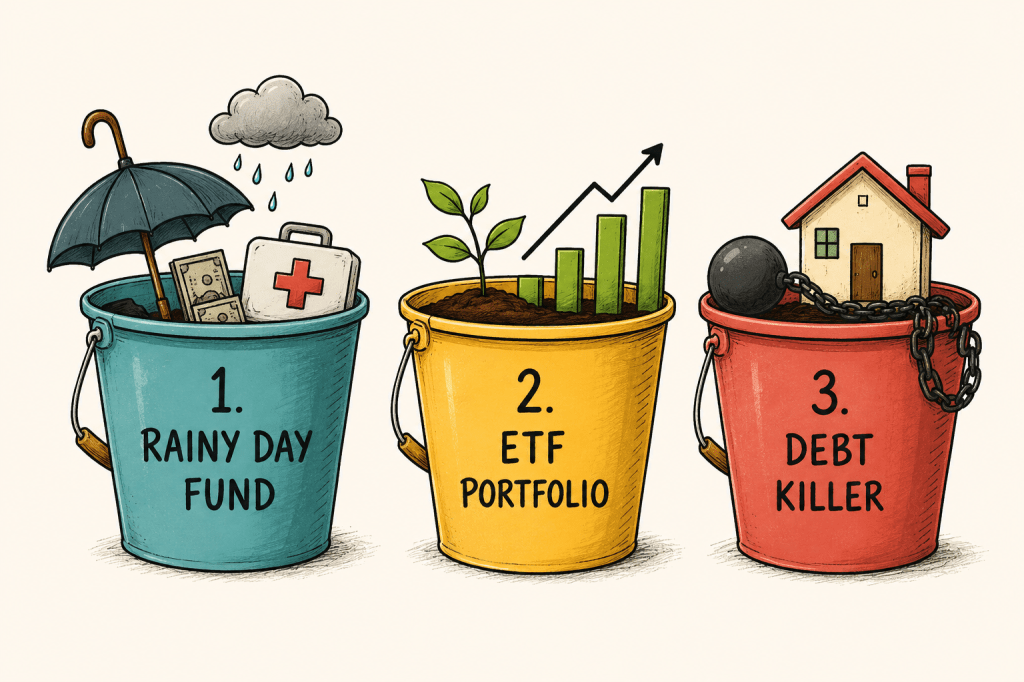
My warm advice to you on their journey to FIRE is to create three financial buckets and work on all of them simultaneously.
You do not need to contribute the same amount to each bucket every month, and you do not need to prioritise them equally at every stage. However, each bucket should have a clear purpose and a strategy behind it. This approach has helped me balance security, long-term growth, and debt reduction without relying on a single financial goal.
Let’s talk about buckets. I know what you’re thinking—sorry to disappoint you. There’s no Phuket Island or Great Wall of China on this list. These are the boring financial buckets.
I run my entire financial life through exactly three of them, and I have one strict rule: I have to work on all three simultaneously.
Here they are, in order of who gets fed first:
1. The rainy-day fund
This is the unglamorous one. The most boring bucket—the one you generally don’t invest in the market, but can still keep in certain bank accounts earning around 3% gross annually.
2. My ETF portfolio
This is currently a modest €5,000, waiting in the corner. It is about to receive much more attention once I switch from Debt-First mode to Investment-First mode, in line with standard FIRE strategies.
3. The equity in my mortgage
This is the bucket I have invested in the most so far through extra payments toward the principal. It grows slowly, whether you look at it or not.
“Simultaneously” doesn’t mean that I contribute the same amount to every bucket every month. It means that I have a strategy behind each one.
I apply different strategies to different buckets.
I will talk extensively about the rainy-day fund later, so for now, let me touch on the ETF bucket.
Be smart about transaction costs
One of the many financial mistakes I have made was investing in my ETF portfolio every month without considering the transaction fee. I use Interactive Brokers, where the fee is approximately €3 per transaction, regardless of the amount invested.
This was highly inefficient because I had been investing €200 per month for years. I discovered the problem last December and decided to invest a larger amount once a year, in January.
In January 2026, I invested €2,400 in one go. My plan for 2027 is much more aggressive.
The point is simple: always calculate the commission charged by the investment platform you use and be smart about it. You may decide to invest once or twice a year in larger chunks and then let the money grow.
Extra mortgage payments
Let’s also talk about extra payments toward the principal.
Some banks have an annual cap: you can repay up to 10% of your mortgage balance without paying a fee. Above that amount, you may be charged.
My bank has an additional clause. I am not charged any fees if the market interest rate is higher than the interest rate I pay on my mortgage. I can guess why. Think about it: if the market interest rate were lower than the rate agreed in my mortgage contract, and I repaid part of the loan early, the bank would lose money. That is why it would charge a fee in that situation.
However, the market interest rate is currently higher than the rate in my contract, so I am not charged even when I exceed the 10% limit—which I have done.
So, read the conditions of your mortgage carefully, including all clauses related to early or additional repayments.
If you have similar conditions, I would make extra payments monthly. I would not wait until I had accumulated a large amount of money. The sooner you repay the principal, the sooner the bank recalculates the interest, and the more money you can save.
Where my cash actually lives
Today, I want to talk extensively about Bucket No. 1: the rainy-day fund—and why I think personal finance internet’s favourite number, six months of expenses, is about as trustworthy as a weather forecast in the Netherlands.
Roughly two-thirds of my rainy-day fund sits in Trading 212, which currently pays 2.40% gross daily. That is the best interest rate I have found anywhere in Europe, as far as my extremely nosy research has been able to determine.
The remaining third sits in Trade Republic, earning 2.25% gross, paid monthly.
Trade Republic does not offer the highest rate on the market. However, it is an actual bank, and that matters to me. I have a debit card that works flawlessly abroad, and I can withdraw more than €100 in cash without paying a commission.
The standard advice of keeping a rainy-day fund that covers six months of expenses is reasonable, but I think it is outdated—especially today, in this era of layoffs and increasing difficulty finding a job, rather than merely finding the job you want.
I am a cautious person, so I have always maintained a 12-month rainy-day fund.
A few years ago, I was laid off. It took me nine months to find another job.
It turns out that the six-month rule and I had very different opinions about how long unemployment could last—and reality sided with me.
My conclusion
A rainy-day fund is not about following a universal rule. It is about understanding your own circumstances: your industry, employability, monthly expenses, family responsibilities, location, and tolerance for uncertainty.
Six months may be enough for some people. For others, it may be dangerously optimistic.
For me, 12 months is not excessive. It is the price I pay for peace of mind—and after experiencing a nine-month job search, I consider it money well spent.
That is also why I strongly believe in my strict three-bucket rule. Even when one bucket is receiving most of my attention, I continue working on all three: maintaining cash reserves, investing for the long term, and building equity in my home.
The amounts and priorities may change over time, but the strategy remains consistent. Financial independence is not built through one perfect decision. It is built by steadily strengthening different parts of your financial life at the same time.
The right number is not the one repeated most often on the internet. It is the number that allows you to sleep peacefully while the rest of your financial strategy continues working in the background.
 Fire in Progress
Leave a comment